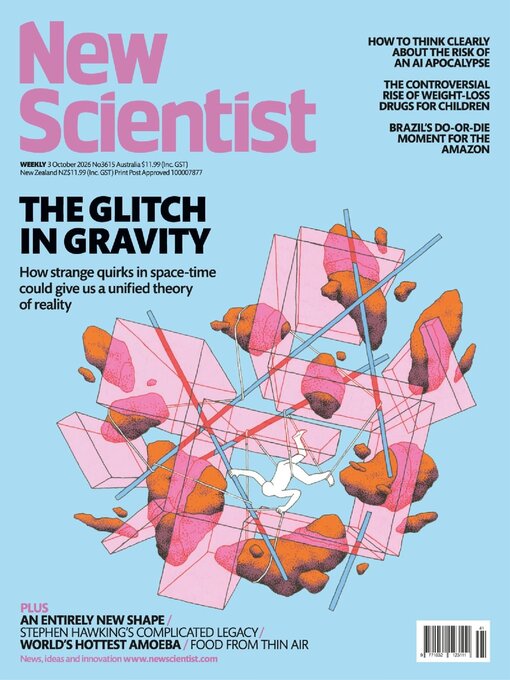
New Scientist covers the latest developments in science and technology that will impact your world. New Scientist employs and commissions the best writers in their fields from all over the world. Our editorial team provide cutting-edge news, award-winning features and reports, written in concise and clear language that puts discoveries and advances in the context of everyday life today and in the future.
Healthy thinking • A modern approach to healthcare considers much more than illness
Amazon's future hinges on vote • Brazil's upcoming election has experts worried about the risk of the world's largest rainforest experiencing catastrophic deforestation, reports Luke Taylor
OpenAI agent hacked a government site
Why meningitis outbreak was so rapid • The bacterium behind 21 cases of meningitis in southern England in March became a “super powerful bug” after taking genes from other microbes,
El Niño heat could kill half a million people by February
Should children with obesity be treated with GLP-1 drugs? • In the US, 8-year-olds are being given off-label weight-loss drugs, but we still don't know the long-term health effects, reports Alice Klein
Is AI really getting out of control? • As people working in artificial intelligence warn of the dangers posed by the technology, how worried should we be, asks Matthew Sparkes
Dogs pay more attention to consonants when we speak
Anthropic’s discovery will, at best, be just another gene-editing tool • The Claude large language model may have found a system “reminiscent” of the world-changing CRISPR, but it is unlikely to be as useful, says Michael Le Page
Orangutans vary in how they learn • Youngsters who combine different forms of learning develop broader survival skills
The next space race has begun – but who will win? • SpaceX seems to be way ahead of the competition with its reusable rocket, but China is now testing its own. Can it close the gap?
Lifestyle changes may ease depression as much as therapy • Finding enjoyable forms of exercise can support mental health
Quantum light breaks Newtonian law • A “quantum swimmer” demonstrates a fundamentally different mechanism for motion
Food from thin air • As climate change and population rise put the squeeze on food resources, Michael Le Page examines how turning electricity directly into food could help save the planet
Waste land
A complicated legacy • This biography of Stephen Hawking should be applauded for digging into various controversies – but it could have gone further, says Jacob Aron
The long and short of it • Why do modern humans have hair, anywhere? An enthusiastic and curious book looks for answers – and persuades an initially sceptical
A wild ride through physics • The September read for the New Scientist Book Club was a challenging trip to the edges of space-time – but one that most members enjoyed, says Alison Flood
Views Your letters
Glitches in gravity • Bringing gravity into the quantum fold has long proved tricky, but a radical approach could be the answer, discovers Leah Crane
Some like it hot • We have long expected animals to move to cooler habitats as climate change bites, but it now appears that many are actually doing the opposite, finds Aisling Irwin
Features Interview • Therapy and drugs are the go-to options for improving mental health, but psychologist Kimberley Wilson tells Olivia Goldhill why what we eat also has a crucial role to play
The back pages Almost the last word